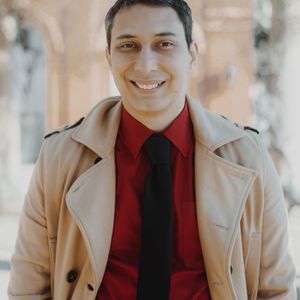
Travis McCallum
$25/hr
Website Copy & Blogs to Engage Your Audience & Match Your Brand
- Reply rate:
- -
- Availability:
- Hourly ($/hour)
- Age:
- 39 years old
- Location:
- Carrollton, Texas, United States
- Experience:
- 10 years
Writing Samples
Writing Samples for Travis McCallum.
You can read my stories on the web at:
http://ntdaily.com/virtual-reality-forecasts-the-future/
http://ntdaily.com/electrical-engineering-program-gears-up-for-its-first-ph-d-graduate/
http://ntdaily.com/source-gaming-provides-a-new-home-for-passionate-gamers/
WRITING SAMPLE #1
Virtual Reality Forecasts the Future
Virtual Reality is available for educational and recreational use for students at the Media Library and The Factory at UNT. The emerging technology offers applications in medical, construction, communication fields, alongside a myriad of others.
Outreach and Program Director Jeremy Kincaid said that there are two software development kits of the SDK Oculus Rift, along with HTC Vive that is equipped with two tripods holding cameras, and a supercomputer to support the VR headset games. The media library wants to mount the cameras above head level to allow for more walking room in the future, but the portability for transportation is nice for now in running events.
"VR is not really a feasible thing for people to buy right now on their own," Kincaid said. "Unless they are really willing to dedicate a lot of time and money to it. So by us having it, it allows people to experience something that is new and upcoming that might not be able to in their everyday life.”
Games are sold through an Oculus Store. Students sit in front of the computer and wear the Oculus VR headset. A remote controller is bought separately. People must purchase games through their personal steam account to use the HTC Vive.
The media library is constantly looking for new types of media. Research is always the first priority in an academic library. For media, film was the initial medium. That has extended to gaming, and now moved on to VR.
The benefits of VR to students are plentiful. They are able to travel to places they normally wouldn’t be able to in the physical world like the Sistine Chapel. Doctors are able to practice on a skeletal system. They get to have fun, relax, make friends and avoid dropping out or missing classes.
"We are engaged in students staying in school," Kincaid said.
The Oculus joined the media library in May 2015 and over 850 students have used it. The Vive arrived May 2016 with over 370 students to use it.
Options to provide games is limited. Games that have multi-use licenses are free downloads that can be shared with all students. Right now each VR headset has four games available. The media library is in an ambiguous place where it provides the hardware, but students need their own software. That is, their own steam or Oculus accounts for single-use licenses to access the full roster of games. Though steam announced they are in the process of allowing exclusive multi-use licenses for libraries.
A future purchase is the Playstation VR which is expected to release in six months. The Playstation is an easier way for everyday people to afford VR. In addition, there are actual physical discs of the game that would eliminate the licensing issue. The media library has a policy to wait six months after the release of a new console to see if it is popular enough to justify buying.
A student will request access to a Oculus headset and PC for a two hour period at the front desk. Staff will help them setup the equipment, or the student can do it themselves. There is a first come first serve policy. However, with the Vive the rules are a bit different. First a student must book both the equipment and room online. They must also be accompanied with at least one other person for safety because there is a large space to walk around with.
“Game On” is a monthly event hosted by the Media Library where all the game consoles, including the VR headsets, are displayed for public use. Something new is revealed each month to showcase the technologies potential. For November, the new game “Martian” is introduced. Essentially a film with interactive elements, Martian tells the story of a man on Mars, inspired from the 2015 movie “The Martian”.
Kincaid expects VR to progress beyond the library. The hands-on engagement provides educational opportunities that lay the ground floor for students. Programmers, doctors, and even police have an alternative experience to train their skills.
“It makes me like I’m actually in the game,” TAMS David Choperro, Engineering, said. “You forget where you are. You forget what time it is. You forget everything. And you are just so deep in the game.”
He describes it as full immersion, imagining himself in his favorite book where he gets to do things he’d never do in real life. His friends told him about the cool technology earlier in the year, but his school schedule didn’t let him see it until the Thanksgiving break, and now he is hooked. Choperro does wish there were more games.
Factory Maker John Knowles highlights Unity, a game design engine that utilizes VR technology at Willis Library. Four fully equipped workstations are available for students to experiment in shop and an Oculus can be checked out, often by Professors for their research projects.
“One of the biggest advantage of Unity is that it publishes games that can take advantage of VR headsets,” Knowles said. “It allows people to really easily get into making really interesting VR applications, interacting with 3-D objects and 3-D space in VR platforms without having to go and do all the back-end coding that you would have to do to build a rendering engine.”
Students interested in learning how to harness the VR technology in full are encouraged to attend the workshops posted on The Factory website. Knowles hopes to implement simulations in future workshops like gardening and emergency training for natural disasters.
First my friends told me they thought it was really cool. And I’m, “Eh, I might as well try it for myself.” And I started using it, just ya know, just ta see what it is like because I’ve never tried VR before. And I’m kinda hooked on it.
WRITING SAMPLE #2
Electrical Engineering Gears Up for Its First PhD Graduate
His deep gruff voice echoes off the white walls of the spacious classroom. He writes algebraic equations on the whiteboard in black marker with his left hand in large, perfect and beautiful handwriting. Rn, Au, Ui, GM symbols litter the board as he reveals hidden solutions with eloquent ease. Students pass notes to each other, bored with the subject of “XX”. Yet he is un-phased by their disinterest, instead engaging in a series of questions, allowing an awkward silence to settle in the airy room… until someone piques up with a meek yes.
Mitch Grabner is the first student to graduate from the College of Engineering’s PhD Program in May at UNT. A program that has been in the works since as early as 2004. Dr. Xinrong Li, Grabner’s advisor explains the impact.
“PhD’s are one of the essential parts of the education program,” Li said. “Lacking a PhD program, the system is incomplete.”
To understand the value of a PhD program, Li describes the tiered levels of degrees in the system. At its foundation is a bachelor degree that is education based, usually specialized in one field. The master’s degree follows where students dig deeper in the theory behind their craft. Finally, the PhD degree focuses on research with open-ended explorations leading to major breakthroughs.
Both local and national industries like economics rely on these breakthroughs to evolve and grow. For instance, Grabner is developing innovations in communication systems that offers high impact research outcomes for stakeholders in telecommunication or UAV technologies.
Creating a PhD program has been the goal of the faculty since the bachelor’s degree was established in 2004. In 2007 the master’s program was created. Finally, enough students were eligible to study for a PhD in 2014. UNT itself is pushing to fill a research university category in order to recruit more students and grow in size. All of the faculty in the Engineering department have PhDs.
The process for establishing a new program is interesting. First, the faculty at the Department of Electrical Engineering must submit a proposal based off a specific template requirement created by a coordinating board, separate from UNT. The board reviews the proposal by bringing in independent members from other universities to probe and ask questions. Questions that test the commitment and resource pool of UNT. The most challenging of those questions is how the Department can differentiate itself from other PhD programs and contend with recruiting future students.
Once the proposal has been sufficiently solidified, it goes through a series of approvals. First, the department pitches it to the Dean provost level. Then it reaches the university level through UNT systems. And finally the state level approves the proposal at the Texas Higher Education Coordinating Board (THECB).
The proposal is approved and UNT creates policy to get it published in the academic catalog. Any minor revisions can be done internally, but major changes require a new proposal submission. The state also requests annual reports to ensure the program is operating properly and up to standards.
The Department of Electrical Engineering has tackled the tough question of having a unique PhD program in its collaboration with the College of Business. Part of the curriculum integrates coursework in entrepreneur and management classes expanding STEM students to become effective communicators and earning a minor in business administration.
Still, there is the obstacle of recruitment for PhD candidates. Dr. Shengli Fu, Chair of the Electrical Engineering Department, explains that recruitment efforts involve outreach at local college fairs and exercises with community and national leaders like emergency services (police, fire, medical) and FEMA. There is the added difficulty of finding domestic students since the ratio to international enrollment is so big.
Mitch Grabner was born in Ontario, Canada. At age 5, he moved to Plano, TX. His father worked for Nortell as an engineer and made math, education and problem-solving a big part of Grabner’s upbringing. In high school, he was interested in computer science and math, winning awards for his effort. At a college fair at Collin Community College, he discovered a UNT booth that would spark the beginning of his 8-year university career.
“It seemed more fun,” he said. “It seemed like an interesting place. A place where you could learn about lots of different things. Everyone seemed so enthusiastic. It seemed like a fun place to be.”
In 2009 Grabner moved into Maple Hall. He jokes at the irony because the leaf reminds him of the Canadian flag. He studied computer engineering for the first year until a digital logic course with Professor Bittle changed his life. His past experience had been in programming, but the logic offered harder work Grabner found fun. As someone who gets bored easily, he constantly strives for challenging work that keeps him engaged. By the end of his freshman year, Grabner switched majors to electrical engineering.
“My dad said, ‘You’ll be more successful and it will pay off more if you go to college.’ So that was basically my driving force was my dad to go to college.”
The passion to do more with hands-on hardware fueled him to take a basic circuit analysis course, where he met his dissertation professor Dr. Li. The class was incredibly hard, and for the first time in his education career, Grabner received low marks. Never discouraged, he stayed up later and spent many all-nighters doing homework. And it paid off. Soon after, Dr. Li recognized that dedication and perseverance, and the pair began a partnership in research bearing fruit in the years to come.
The switch to electrical engineering changed Grabner’s hobbies too. He worked as a mechanic in the summer and designed hobby amplifiers just like his father did when he was a kid. He branched out into other programs on campus like the Institute of Electrical and Electronic Engineers (IEEE) and the Tutoring program, where he would meet life-long friends.
“I helped them with Statistics or Circuit Analysis, and we would hang out and end up going to Lou’s on Saturdays all the way up until we graduated undergrad,” he said. “I met lots of friends doing that, which was unexpected but nice.”
At the end of his undergraduate career, Grabner continued to pursue challenging content in his senior problems class, so much so that his professors had to tone down his pace. Taking note of his passion for hard work, they encouraged him to apply for the master’s program if to explore the more difficult problems in electrical engineering. His decision came down to figuring out two things: how to work in the industry, and how he can find ‘crazy hard stuff’ he wants to research about.
From those questions, Grabner began a project in communication systems using circuit analysis and Dr. Li’s guidance as a foundation in his Masters and PhD research. The process would be a tiered approach compounding information with waypoints along the way. He examined cellphone wireless communication systems as parts, working to improve each area to be better, stronger and faster. Grabner fondly remembers Dr. Li saying, “Double-check your results. Make sure everything is correct.”
“I remember Dr. Li is always like, ‘Double check your results. Make sure everythings correct.’ Right, so make sure all the methods are correct because everything is too good, and I was like, ‘should the results be this good?’ He was like, ‘you’ve got to double check and make sure everything is correct.’ It was really funny so, we didn’t really know how good it can get until we tried.”
Grabner loves doing research, but teaches classes to kill time. He is well acquainted with all the professors in the electrical engineering department like Dr. Guturu, whom he found out worked with his father at Nortell some years ago.
The development of the PhD program for the College of Engineering received a lot of student input too. Drafting meetings from independent professors would ask Grabner about his experience in the department and what he would like to get out of a PhD program.
Grounded in his brown loafers, Grabner moves firmly from spot to spot, standing erect, a tower of impenetrable defense with a lust for knowledge, expelling the notes he holds tightly in his right hand. He looks at the class, lifting his thick black-rimmed glasses up his perfectly linear nose, and points with an outstretched arm at each equation on the board. Grabner fosters the future engineers of tomorrow with a passion of knowledge he zaps into their souls.
WRITING SAMPLE #3
Source Gaming provides a new home for passionate gamers
Fervor washes over the fingers of gamers pushing desperately to claim the victory prize. The crowd stares in awe, commenting on bold plays the fierce competitors make on the big screen. A charismatic announcer echoes each compounding action until “thud!” The audience lets out a deafening cry in the viewing room at Denton’s newest e-sports lounge, Source Gaming.
Robert McAshan opened doors to his new business on Jan. 5. Source sets the precedent for a new wave of consumers to engage in video games, or what he calls “a community for gaming.”
As a small town with over 100,000 people and a concentrated culture point for diversity with two universities, many gamers in Denton were hoping for a space dedicated to gaming. McAshan hopes his niche will build a community for demanding gamers in town.
“Denton can be a fickle mistress,” he said.
McAshan never imagined he would be the owner of a video game lounge. McAshan jokes he was a career college student in school for 12 years since 2003. He graduated with a BA in general studies from Schreiner University in Kerrville, Texas, then completed a BS degree in mechanical engineering and technology at UNT and finished with a masters degree in 2014. Throughout his full-time college career, McAshan worked for 10 years at Daniel Measurement & Control, an oil and gas company in Houston.
After graduating from school, McAshan knew he didn’t want to work in the oil and gas industry forever, so he left to take a yearlong vacation to find the right job for him. Not getting hired, he eventually created his own job as owner of Source Gaming.
McAshan said Source Gaming sets itself apart from companies in the past because it doesn’t nickel and dime customers to play video games, and they are free to experiment with virtual reality technology or attend tournaments. Members are able to play their own games or the many free-to-play titles offered, including League of Legends and Final Fantasy XV. The goal is to fill all the machines while keeping the prices low.
Source is meant to operate as a third home or space for high school and college students. Parents are also an ideal consumer with an option for parental controls when they bring their children.
An entire room is available with two HTC Vive headsets for maximum exposure to virtual reality. McAshan jokes at the intense battleship games players simulate. There’s even a Playstation VR headset for people who prefer console play sitting down.
“When we went off to the E3 [gaming convention], the two biggest buzz words were e-sports and VR,” Marketing Director Warren Lee said.
Different events allow Source to collaborate with organizations like TESPA UNT, an e-sports organization. An ongoing program called the Red Line Series features weekly tournaments like SMASH 4 where players will have the opportunity to compete for prize money in their favorite video games. Talks are in the way to include local businesses, like More Fun Comics.
Revenue is expected to come from two different mediums. One method will be from concessions provided when customers come for the watch parties and big events, while the other method will be from an unlimited monthly gaming pass of $35 for students and military personnel and $45 for the general public.
“There’s a different energy that comes from playing games with people in the same room,” Lee said.
Lee said that Source provides something the internet can’t replicate. People come to Source for the same reason they go to conventions— an experience for the community. People are also able to have access to a facility where they can consistently hone their skills with enhanced equipment.
Derek Hanson, a computer science senior at Texas State University and part-time Source employee, said he likes how there are plenty of high-end PCs to play because not many other places are well priced. Competitor gaming lounge ShadowLAN in Richardson offers a $30-day pass, triple the amount Source Gaming is charging.
“There’s so much room for so many people,” Hanson said. “It feels very spacious and comfortable.”
A big challenge for McAshan is getting the word out that Source Gaming exists. The e-sports industry is in a volatile position where businesses fail more often than they succeed. Two years ago, Epic! Gaming Lounge in Frisco closed after a scandal involving stolen sponsorship money. McAshan’s hope is that his transparent actions in pricing, event management and commitment to the community will make Source Gaming a credible and enjoyable staple in Denton.
McAshan plans to upgrade the facility expanding new game stations so more people can play at a time. Currently, there are 18 available PCs, and 24 are needed, with 30 being the ideal number to maximize gaming tournaments. It continues to expand the game library and console lineup including the new upcoming Nintendo Switch.
“We want to operate it as a third home space,” Lee said.